
Designing for Longevity: Practical Lessons for Smarter School Renovations
Why it matters
If you’re a school principal or building manager planning a refurbishment, you’re likely balancing big expectations with tight budgets, ageing buildings, and very real time pressures. The decisions you make, often on finishes that seem “minor”, can either save you years of maintenance, replacement, and disruption… or quietly drain resources long after the builders leave.
This blog is written to help you avoid wasted money, wasted time, and wasted effort. It distils what we’ve learned delivering decades of school upgrades into clear, practical guidance—so your investment delivers durable, cost-effective solutions that genuinely support teaching and learning for years to come.
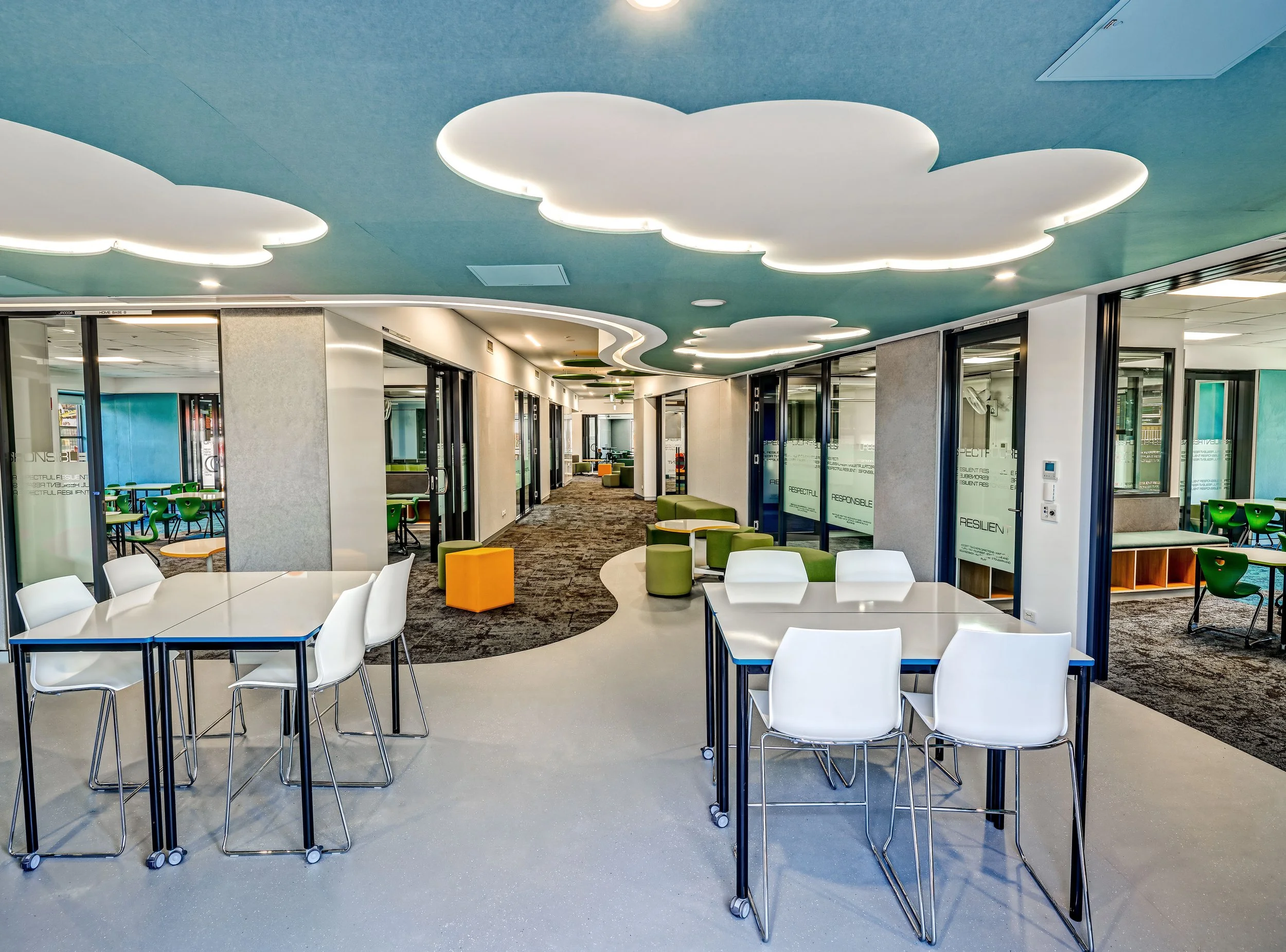
William Stimson Public School
What’s Enduring vs What’s New
Good school design isn’t about chasing trends. It’s about understanding what should last, what can evolve, and how each decision supports learning.
Before asking “what looks good?”, we always ask:
What is the purpose of this element?
Why does it exist in a learning environment?
How will it perform over 5, 10, or 20 years?
Below are some of the most overlooked, but most impactful, decisions in school refurbishments.

St Christopher’s Panania
The Purpose of Surface
Ceilings: hide or show?
Ceilings are often treated as an afterthought - yet they affect acoustics, maintenance, cost, and visual calm. Replacing an old or damaged ceiling can immediately brighten a space, also providing the to upgrade to services, lighting and cabling above.
What we’ve learned:
Hiding services is usually the simplest and most cost-effective approach.
A standard suspended ceiling remains our “go-to” for most learning spaces.
Best practice options:
600 x 600 lay-in grid ceilings for learning spaces, 1200 x 600 for corridors. Larger tiles run in the direction of travel, whereas smaller tiles are less institutional. All lay-in grid ceilings offer:
Easy access to services
Flexible for future changes
Cost-effective to install and maintain
Coordinate lighting, dimmers, speakers, and smoke detection above the grid early to avoid costly rework later.
Use drop ceilings selectively in breakout areas to create intimacy and acoustic control.
Acoustic plasterboard or timber acoustic panels can work well—but only when backed by the proper insulation and appropriately detailed.
Special features (like starlight ceilings in sensory or breakout rooms) should be deliberate exceptions, not defaults.
Key principle:
Standardise where you can. Innovate where it genuinely adds value.
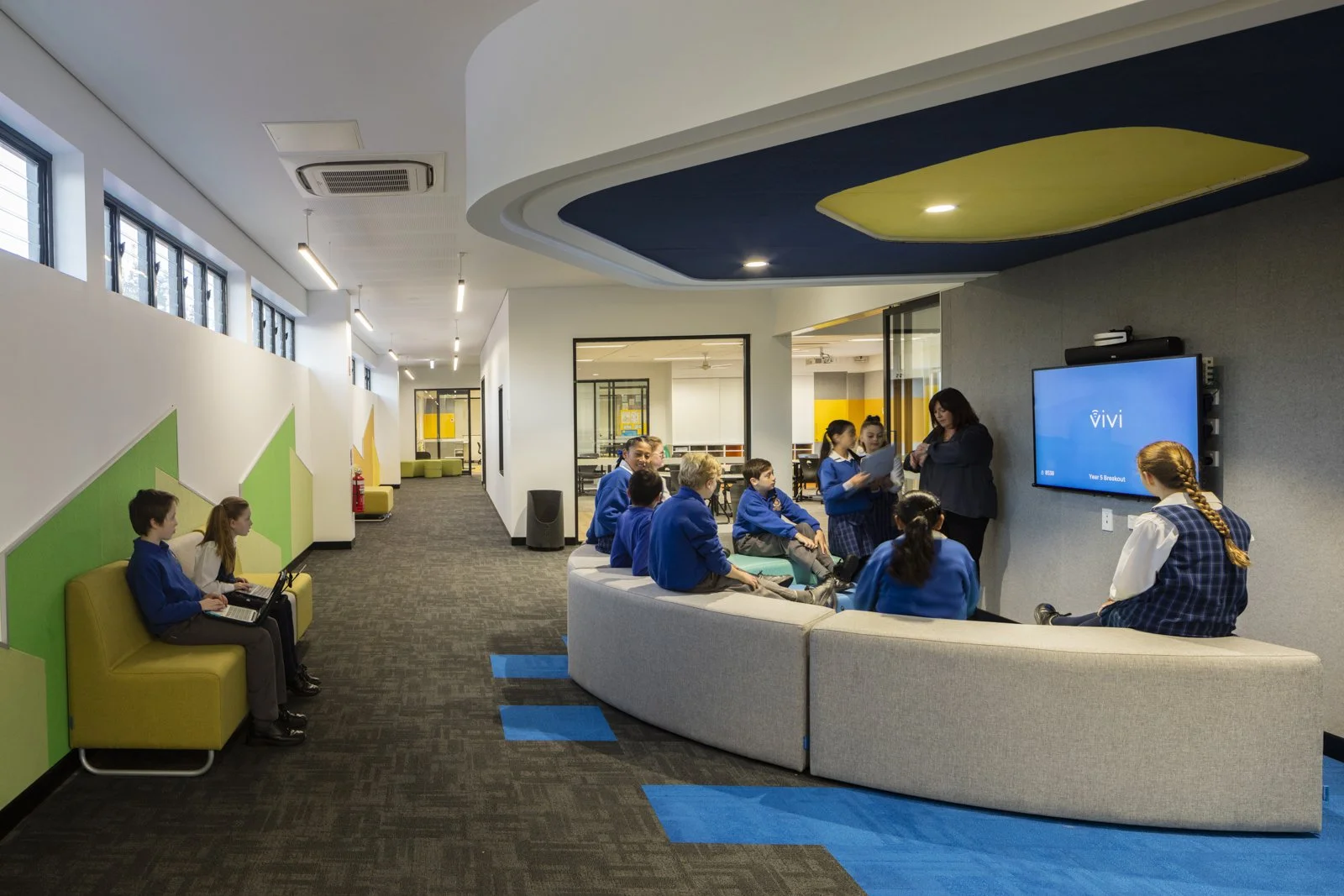
St Catherine Laboure, Gymea
Walls: working harder, every day
In schools, walls are not just boundaries; they are essential surfaces for teaching and learning.
Our approach:
Treat walls as active learning surfaces.
Combine pinboard, acoustic treatment, and writable areas wherever possible.
Minimum 1500 mm wide whiteboards; anything smaller limits teaching flexibility.
Pinboards should be:
Durable
Colour-considered (for wayfinding and age-appropriateness)
Mounted to a minimum height of 1800 mm, though full height pinboards offer additional acoustic benefit, and resilience to wear and tear in high traffic areas
Detail matters:
Use a 50 mm aluminium U-channel between the pinboard and the whiteboard for durability and clean transitions.
Be careful with colour – choosing a neutral colour brings focus to the display, but avoid black unless rooms are flooded with natural light.
Top tip:
If it’s essential, detail it. Precise detailing ensures installation is robust and maintenance-free, and avoids substitutions and compromises on site.
Doors: never an afterthought
Doors are one of the most heavily used elements in a school, and one of the easiest to get wrong.
Our non-negotiables:
Every classroom gets a door.
Doors should be glazed or include vision panels. Visibility supports supervision and safety.
Always specify:
Solid core doors – min 2400mm high
Large glass cavity sliders work beautifully between classrooms, but only when structural steel is coordinated early with the engineer. (Consider openings up to 3.2m wide, as cost increases exponentially with size)
External doors:
Minimum 900 mm wide x 2400 mm high
Three hinges are specified as standard
Avoid double doors unless there is a clear, functional reason; they cost more and often perform worse.
Colour is not decoration here, but applied as a wayfinding and identity tool.

William Stimpson Primary School
Floors: where durability meets design
Flooring choices can quietly undermine a space if handled poorly.
What works best:
High to mid-range carpet tiles, in coordinated colours. Lay patterns sparingly, unless at doorways or transition zones. Carpet tiles are:
Easier for builders to price accurately
More forgiving during installation
Better long-term replacement strategy
Include this clearly in the finishes schedule; don’t leave it vague.
What to avoid:
Over-use of vinyl, especially “institutional grey” finishes.
Slip ratings where they’re not required.
Visual zoning that signals “wet area” in learning spaces when it isn’t needed.
Design the details:
Transition strips matter; design them, don’t leave them to site decisions.
Skirtings and stair junctions should be resolved early to avoid damage and patchwork fixes later.

Carpet tiles by Interface Flooring
The takeaway
The most successful school refurbishments aren’t defined by bold gestures, they’re defined by hundreds of small, well-considered decisions.
At JDH Architects, our focus is always on:
Designing once, and designing thoughtfully
Reducing future maintenance and disruption
Creating environments that consistently support learning, and the learner
When you get the fundamentals right, ceilings, walls, doors, floors, you don’t just save money.
You create schools that work better, last longer, and give teachers and students spaces where they can truly shine.
If you’re planning a refurbishment, start by asking:
What do we want to endure?